
Behind the Balance: Colin Crenshaw ’27 — Keydet Cross Country

Â鶹´«Ã½Èë¿Ú’s cadet-athletes have to juggle cadet life, heavy academic course loads, and their NCAA Division I sport. Committed to both academic and athletic pursuits, balancing their rigorous schedule in both sports and school requires a certain level of commitment and discipline. Behind the Balance is a series that focuses on those cadet-athletes and how they handle the hurdles of the day-to-day.
Uncertainty after high school is normal and something Colin Crenshaw ’27 faced upon graduation. It’s one of the reasons he decided to attend Â鶹´«Ã½Èë¿Ú.Â
“I didn’t really know what I wanted to do after high school, but I knew if I came here, there would be lots of doors that would be open,â€� he admitted.
The chemistry major also had the opportunity to run cross country and track at VMI, something he fell in love with at a young age.
“I started running cross country in middle school because my mom convinced me to, because she told me I’d get faster for basketball,â€� he said. “I ended up not being that good at basketball. I fell in love with running. I had a good coach when I first started, and he kind of helped me fall in love with the sport and just pushed me to see how good I could be.â€�
He likes how cross country makes him more accountable.
“I like that it’s all on me,â€� he commented. “I don’t have to rely on other people. If I do bad, it’s on me. I think it really tests what you’re made of when you’re out there by yourself.â€�
The 2nd Class cadet has a heavy load this semester with 19.5 credit hours.
“Especially here at VMI, there are not a lot of moments where you get to sit back and think,� Crenshaw commented. “I use running to do that.�
Cadet-athletes at Â鶹´«Ã½Èë¿Únot only have their responsibilities with their selected sport but cadet duties on top of that. Cadets are also required to take physical fitness classes twice a week, participate in ROTC all four years, prepare for room and uniform inspections, practice for parade, guard duty, and more.
He’s up before 6 a.m. most days for morning runs. His weekly mileage is between 55 and 60 miles. He’s then in class from 8 a.m. until 3:30 p.m., then he’s off to a 4 p.m. practice.
“I just take it one thing at a time and try not to get overwhelmed,â€� he said. “I know it’s just going to prepare me well for the future.â€�
Crenshaw said he tries to fit in schoolwork between classes, so he’s not staying up late to finish assignments.
The workload he has at Â鶹´«Ã½Èë¿Ú— with academics, athletics, and cadet responsibilities — will help him later in life. Something he is looking to pursue after graduating is attending medical school. Crenshaw is currently a cadet EMT.
“I think the biggest thing is time management. That’s something I really learned here that I didn’t have to focus on before,â€� he stated. “I also think Â鶹´«Ã½Èë¿Úteaches you that you’ve got to be doing what you’re supposed to be doing. I think that just that discipline will help me in the future.â€�
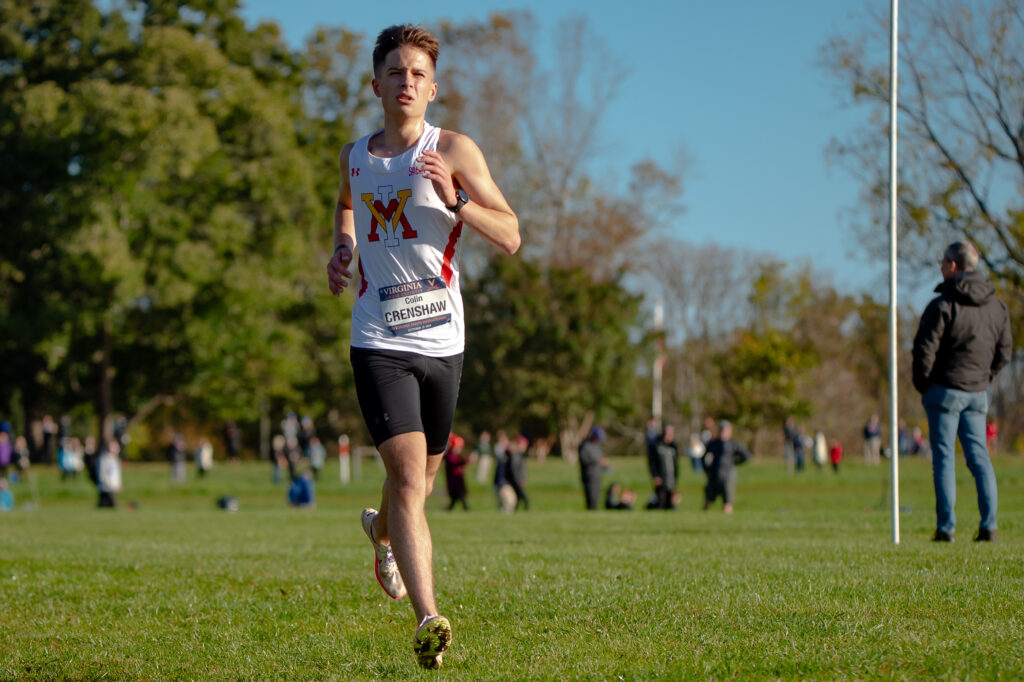
He tries to take victories where he can and start with the small things.
“One thing I like to do when I’m working is if I have something small or not that significant, that’s not going to take me very long, I like to do that thing first, so I can get one thing done,â€� he explained. “Rather than trying to do an overwhelming project first.â€�
As a cadet EMT, Crenshaw is able to pick and choose what events he’s able to cover. It all has to fit into his sports and academic schedule.
“I always knew that I wanted to do something where I actually made a difference and helped people,â€� he said. “I didn’t want to just sit behind a desk and click around in Excel files. That’s something I’ve always known about myself.â€�
The busyness of life at Â鶹´«Ã½Èë¿Úis something Crenshaw enjoys and thrives on.
“That’s the one reason I thought I would do well here,â€� he said. “I don’t like sitting around being bored. That’s when I get myself into trouble. It’s not good for me to be bored.â€�


