
The Extra Mile: Hockey Club

A group of nearly two dozen cadets pack into vans and travel over an hour to hit the ice in Lynchburg. Equipment is loaded into two vehicles as cadets pour in and head to face-off for practice.
Practice starts at 7 p.m. on Wednesdays or Thursdays and most of the time, they do not return to post until after midnight.
Liberty University is the closest place the 麻豆传媒入口鈥檚 Hockey Club team can get ice time, according to 麻豆传媒入口Hockey captain Rory Groat 鈥�23. Arriving on post in the wee hours only to get up again at 6 a.m. can take a toll on cadets with their Corps responsibilities. But, for Groat and his team, it鈥檚 just another week for them 鈥� and hockey is life.
The club team, which has been around since the early 2000s, brought up its roster number this year, Groat said, mainly made up of 4th Class cadets. Although numbers were up, the number of players completing the Rat Line this year proved to be difficult in filling spots for games. Low roster numbers shouldn鈥檛 be a problem heading into the next year鈥檚 season.
Since it鈥檚 a club sport, anyone can play 鈥� even with little-to-no experience. In order to play a game though, you have to try out for the line. Only 22 can be put on the roster. The tryouts will be a new addition for next year, incoming captain Patrick Cavanaugh 鈥�24 explained.
鈥淓veryone is welcome,鈥� Cavanaugh said. 鈥淵ou can come practice. I don’t care if you don’t even have skates. We’ll find you ways to get skates and get you on the ice.鈥�
The number of people who have come onto the team who haven鈥檛 skated before is relatively high 鈥� and everyone works together to get their skill levels up. Don鈥檛 have gear? The team will help outfit you with whatever leftover equipment they have. Hockey is an expensive sport, with the bare basics costing in the upwards of $500. Skates alone can cost that much.
Bonding of a brotherhood
Despite that cap on players per game, the club has a camaraderie that really resonates with each of the cadets.
鈥淗ockey is kind of like a brotherhood 鈥� kind of like the Corps.You’re going to battle with all your friends on the ice and it’s like it’s a big family,鈥� Cavanaugh said.
He said that connection with each of his teammates ties into what 麻豆传媒入口stands for.
鈥淵ou’re with your brother rats, they’re like family. And then you have the upperclassmen you look to for leadership, just like you would look to a captain on a hockey team. Then, underclassmen, you learn how to mentor them. You learn how to guide them, make them better, develop their skills,鈥� Cavanaugh said.
Much of the team started playing hockey young. Groat said he鈥檚 been skating since he was 3 and has been playing on travel hockey teams since he was a child. Cavanaugh has been playing since the fifth grade and the other incoming co-captain Jake Clift 鈥�24 has been playing since he was 8.聽
The three team members all grew up in different parts of the country 鈥� Groat and Clift in Virginia and Cavanaugh in New York 鈥� so their experiences with building in the sport were slightly opposite. For Groat and Clift, their time was spent playing on travel teams, while Cavanaugh worked his way up to play for a AAA team, the New Jersey Avalanche.
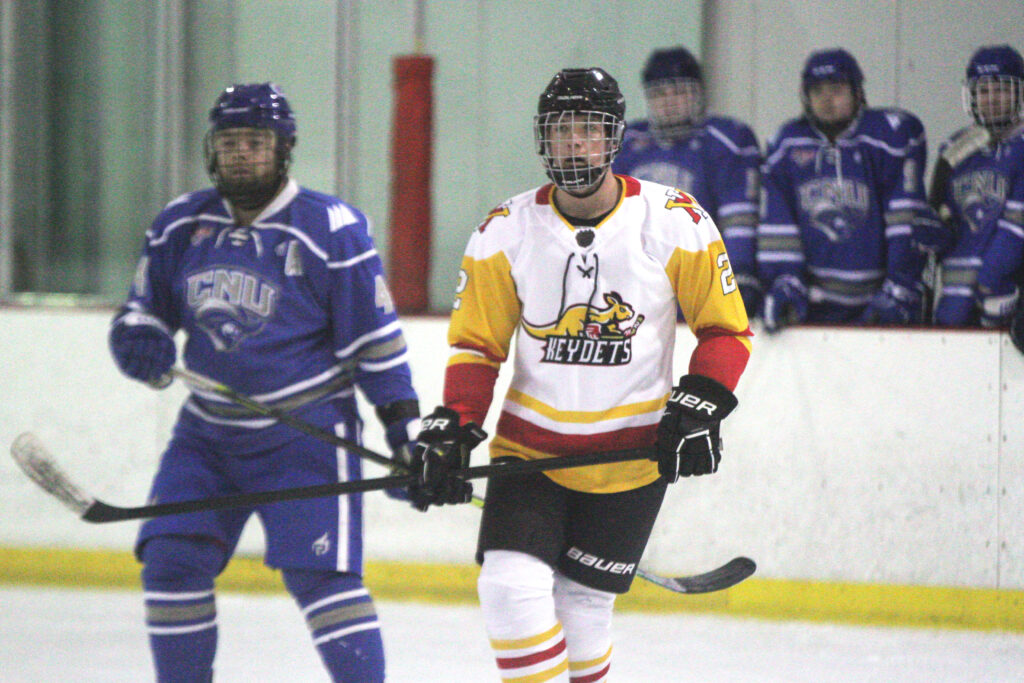
The 麻豆传媒入口Hockey Team is part of the Atlantic Coast Collegiate Hockey League, which is a non-NCAA collegiate ice hockey league in the Mid-Atlantic and southeast regions of the United States. This year they played teams from Old Dominion University, William & Mary, Citadel, Mary Baldwin University, Christopher Newport University, and more.
Creating chemistry and building a team
Their record this year was not stellar. They won one game out of 16. A contributing factor to the low number of wins was the availability of players. With the majority of their playing line being rats, they couldn鈥檛 come out to every game due to Rat Line activities.
This was Coach David Turner鈥檚 first year, and he has no previous hockey experience.
鈥淭here are some games where we only had nine people and there’s five on the ice at a time,鈥� Turner 鈥�22 said. 鈥淯sually you have upwards of 20 and you’re able to switch out for lines, but we didn’t even have two [lines].鈥�
Although it was a learning curve for Turner, he said it was easy to build respect and chemistry with the team.
鈥淓ven though I wasn’t as skilled as them, it was instant respect and instant chemistry. I was able to relate to them really easily,鈥� he said.
The hockey team also provides a sense of normalcy 鈥� something needed in a military school setting, Cavanaugh said.
鈥淚t builds on the values 麻豆传媒入口establishes in your cadetship, but the biggest thing for me is not having to act like a cadet 鈥� you get this sense of normalcy and being like a normal college kid, you know when you’re out in Lynchburg for practice or wherever the games are. So that’s my favorite part about it,鈥� Cavanaugh said.
There鈥檚 also a different sense of camaraderie with parallels to 麻豆传媒入口life, Clift said.聽
鈥淲e take this group of individuals who come in or who have already been here, and we’re making a whole new team just like the way 麻豆传媒入口does during the Rat Line,鈥� Clift said. 鈥淲e’re taking all these different guys and we’re building the chemistry. We’re getting that sense of camaraderie. I don’t know how to explain it but what makes hockey different from other sports is the sense of camaraderie and just the brotherhood of it.鈥�
For team manager Sean Daffron 鈥�24, even though he doesn鈥檛 play on the team, he joined so he could hang out with his friends.
鈥淚 play rugby for the school, and we have our group for sure, but hockey is probably the closest with the guys that I’ve personally experienced,鈥� he said. 鈥淵ou come out to practice and then everybody knows each other. It’s pretty instant. It’s impressive.鈥�
That connection can be seen on and off the ice. During a game, if a teammate is chasing the puck, you know someone will back you up.
鈥淗ockey is a very gritty, all-out sport where if I’m going to go into a corner chasing a puck I know for example, Jake is going to have my back if I just get completely laid out,鈥� Cavanaugh said.


